
Legally Reviewed by Boyd Hoekel on July 30, 2026
Owning investment property in Texas opens the door to significant wealth-building opportunities, but it also exposes investors to risks that public ownership records can amplify. When your name appears on a deed, it signals to potential claimants, creditors, and litigants exactly what you own and where. A land trust quietly removes that vulnerability by placing legal title in the hands of a trustee while you retain control and the economic benefits of your investment.
At Quadros, Migl & Kilmer, our team brings over 60 years of combined legal experience to Texas investors navigating real estate ownership structures. With offices in Houston, The Woodlands, Dallas, and Austin, we work alongside real estate investment clients to evaluate tools such as land trusts as part of a broader real estate law strategy tailored to your specific goals.
What Is a Land Trust and How Does It Work?
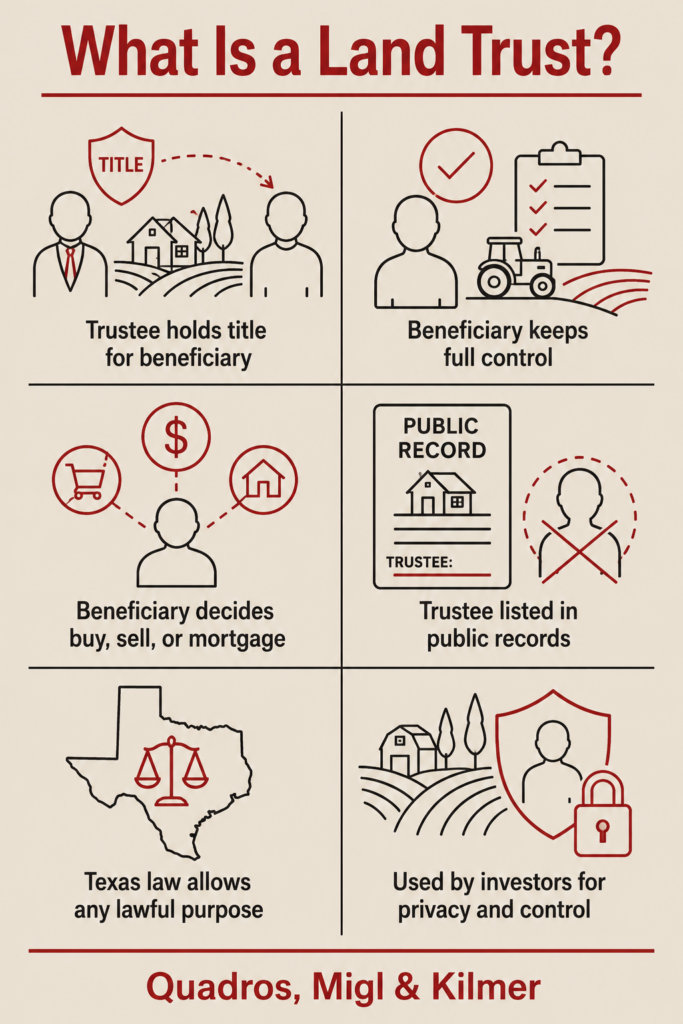
A land trust is a legal arrangement in which a trustee holds title to real property on behalf of a beneficiary. Individuals use land trusts to keep property ownership private while continuing to manage investments and benefit from the trust’s flexibility. In Texas, trusts may be formed for any lawful purpose under the Texas Trust Act, codified in the Texas Property Code.
In a typical Texas land trust, the investor transfers title to a named trustee. The investor, as beneficiary, retains full control over management decisions, receives income from the property, and directs the trustee when to buy, sell, or mortgage the asset. To the outside world, however, the trustee’s name appears in the public property records rather than the investor’s name. This structural separation is the reason so many Texas investors incorporate land trusts into their holdings.
Key Benefits for Real Estate Investors
Land trusts offer a range of practical advantages for investors at every stage of portfolio growth. The following are among the most significant benefits to understand before deciding whether this structure fits your situation.
- Privacy: Because the trustee holds title, your name is not listed on public records, reducing your visibility to claimants and creditors.
- Probate avoidance: Property held in a land trust passes to successor beneficiaries without going through probate, which can be time-consuming and costly.
- Simplified transfers: Beneficial interests in a land trust can be transferred without recording a new deed, reducing transaction costs and administrative complexity.
- Portfolio management: Multiple properties can be held in separate trusts, creating a clear organizational structure that supports growth and simplifies transactions.
- Coordination with estate planning: Land trusts can be integrated with broader estate planning instruments, allowing investors to align property ownership with succession goals.
Each of these benefits carries its own considerations, and the right approach depends on your overall investment structure and goals.
Important Limitations Investors Must Understand
A land trust is not a liability shield. Unlike an LLC or corporation, a land trust does not protect the beneficiary from personal liability arising from the property. If someone is injured on property held in a land trust, the beneficiary may remain exposed to claims. Investors who prioritize liability protection should consider pairing a land trust with an LLC, a topic we explore in our post on the benefits of an LLC for real estate investment.
Additionally, Texas lacks a specific land trust statute comparable to Illinois’s well-known framework. This means land trusts here operate under general trust law, and their enforceability in certain contexts, such as financing, can require careful drafting. Lenders may require the beneficiary to sign personally, which can affect the privacy protections investors seek. Working with knowledgeable legal counsel from the outset ensures the trust is structured to withstand real-world transactions.
Land Trusts and Existing Mortgage Financing
Investors who already hold a mortgage on a property often ask whether transferring title into a land trust triggers their lender’s due-on-sale clause, which allows a lender to demand full repayment if title changes hands. Federal law provides a narrow exemption for transfers into certain inter vivos trusts where the borrower remains a beneficiary and occupant of the property, but this exemption is written for owner-occupied residential property and does not automatically extend to every investment property transfer.
Because the exemption is fact-specific and lenders vary in how they interpret it, investors should review their loan documents and confirm the trust structure with counsel before recording a transfer, rather than assuming the exemption applies. In some cases, notifying the lender or obtaining written consent before the transfer is the more prudent path, particularly for investment and commercial properties where the residential exemption may not apply cleanly.
How Land Trusts Fit Into a Broader Investment Strategy
For investors holding commercial real estate or managing multiple residential properties, land trusts are rarely used in isolation. They are most effective when combined with other legal and financial structures addressing privacy, liability, estate planning, and tax considerations. Understanding how title is held also intersects directly with issues like title insurance, and reviewing what investors should know about title insurance in Texas is a practical complement to any discussion of land trusts.
Before transferring property into a land trust, investors should evaluate the implications for existing financing, insurance coverage, and any partnership agreements governing the asset. A well-drafted trust agreement is essential, and the trustee’s duties and limitations should be clearly defined to avoid disputes down the line.
Setting Up a Land Trust in Texas: What to Expect
Establishing a land trust generally involves a small number of coordinated steps, though the details should be tailored to each investor’s holdings and goals.
- Drafting the trust agreement: This private document names the trustee, identifies the beneficiary, and spells out the trustee’s limited duties and the beneficiary’s retained powers of direction.
- Selecting a trustee: The trustee holds legal title and acts on the beneficiary’s written direction. Many investors use an attorney, title company, or dedicated trust entity rather than an individual.
- Recording the deed transfer: Title is conveyed from the investor to the trustee, with the trustee’s name appearing in the county property records going forward.
- Documenting the beneficial interest: A separate assignment of beneficial interest confirms the investor’s economic ownership and control, without being recorded publicly.
Because each of these steps has downstream effects on financing, insurance, and eventual resale, investors are generally better served by having counsel review the full structure before any documents are signed or recorded.
Frequently Asked Questions About Texas Land Trusts
Does Texas have a specific land trust statute?
No. Unlike Illinois, Texas does not have a dedicated land trust statute. Land trusts in Texas are formed and governed under general trust law codified in the Texas Property Code, which means careful drafting is especially important to ensure the trust holds up in financing and other real-world transactions.
Does a land trust protect an investor from liability?
No. A land trust provides privacy and probate avoidance, but it does not shield the beneficiary from personal liability related to the property. Investors seeking liability protection typically pair a land trust with an LLC or similar entity.
Will transferring property into a land trust trigger my mortgage’s due-on-sale clause?
It depends on the loan terms and the nature of the trust. A federal exemption covers certain transfers into trusts for owner-occupied residential property, but it does not automatically extend to every investment property transfer. Reviewing loan documents with counsel before recording a transfer is the safer approach.
Who should serve as trustee of a Texas land trust?
Many investors select an attorney, title company, or dedicated trust entity to serve as trustee rather than an individual, since the trustee holds legal title and must act consistently on the beneficiary’s written direction.
Can I hold multiple properties in a single land trust?
While it is possible, many investors use separate land trusts for separate properties to keep ownership records distinct and to simplify individual transactions, transfers, or refinancing down the line.
Quadros, Migl & Kilmer: Texas Real Estate Legal Counsel
Texas real estate investors have a lot to gain from understanding how land trusts can fit into their overall ownership and planning strategy, but structure matters as much as intent. At Quadros, Migl & Kilmer, we help clients across Houston, The Woodlands, Dallas, and Austin make informed decisions about how to hold and protect their assets. Our attorneys bring big-law depth with the personal, client-focused service that boutique representation offers.
If you are weighing whether a land trust makes sense for your portfolio, we are here to help you evaluate your options clearly and thoroughly. Reach out to our team through our contact form to schedule a consultation.
About the Attorney
Commercial Litigator, Quadros, Migl & Kilmer
Boyd Hoekel joined Quadros, Migl & Kilmer after thirteen years managing the nationwide commercial litigation docket for a major commercial real estate investment firm, where he worked extensively with complex property and lease structures. He is admitted to practice in Texas and before the U.S. Court of Appeals for the Fifth Circuit.