You have spent years building your business, growing your real estate portfolio, and securing your family’s financial future, but without the right legal framework in place, everything you have worked for could be delayed, exposed, and tied up in a Texas probate court after you are gone. For business owners with complex asset structures, probate is more than a bureaucratic inconvenience. It can freeze business operations, expose financial details to the public, and force costly delays at precisely the moment your family and partners need stability.
At Quadros, Migl & Kilmer, we understand the intersection of business ownership and personal legacy better than most. As a boutique firm with offices in Houston, The Woodlands, Dallas, and Austin, our attorneys bring over 60 years of combined legal experience to estate planning strategies built around your full financial picture. We provide cost-effective, client-first, practical legal solutions that protect what you have built and give your loved ones a clear path forward.
What Is a Revocable Living Trust?
A revocable living trust is a legal arrangement you establish during your lifetime, transferring ownership of your assets into the trust while retaining full control as the trustee. You can modify or dissolve it at any time. As noted by the Legal Information Institute at Cornell Law School, a revocable living trust serves as a substitute for a will, with title transferring during the donor’s lifetime and benefits passing to beneficiaries upon the donor’s death. When you pass, a successor trustee you have designated steps in to distribute assets directly to your named beneficiaries, bypassing the probate process entirely.
For business owners, this distinction matters enormously. A will must be validated by a Texas probate court before any assets can move, which takes time and creates a public record. A properly funded revocable trust transfers business interests, real estate holdings, and financial accounts seamlessly and immediately, without court involvement.
Key Benefits of a Revocable Living Trust for Texas Business Owners
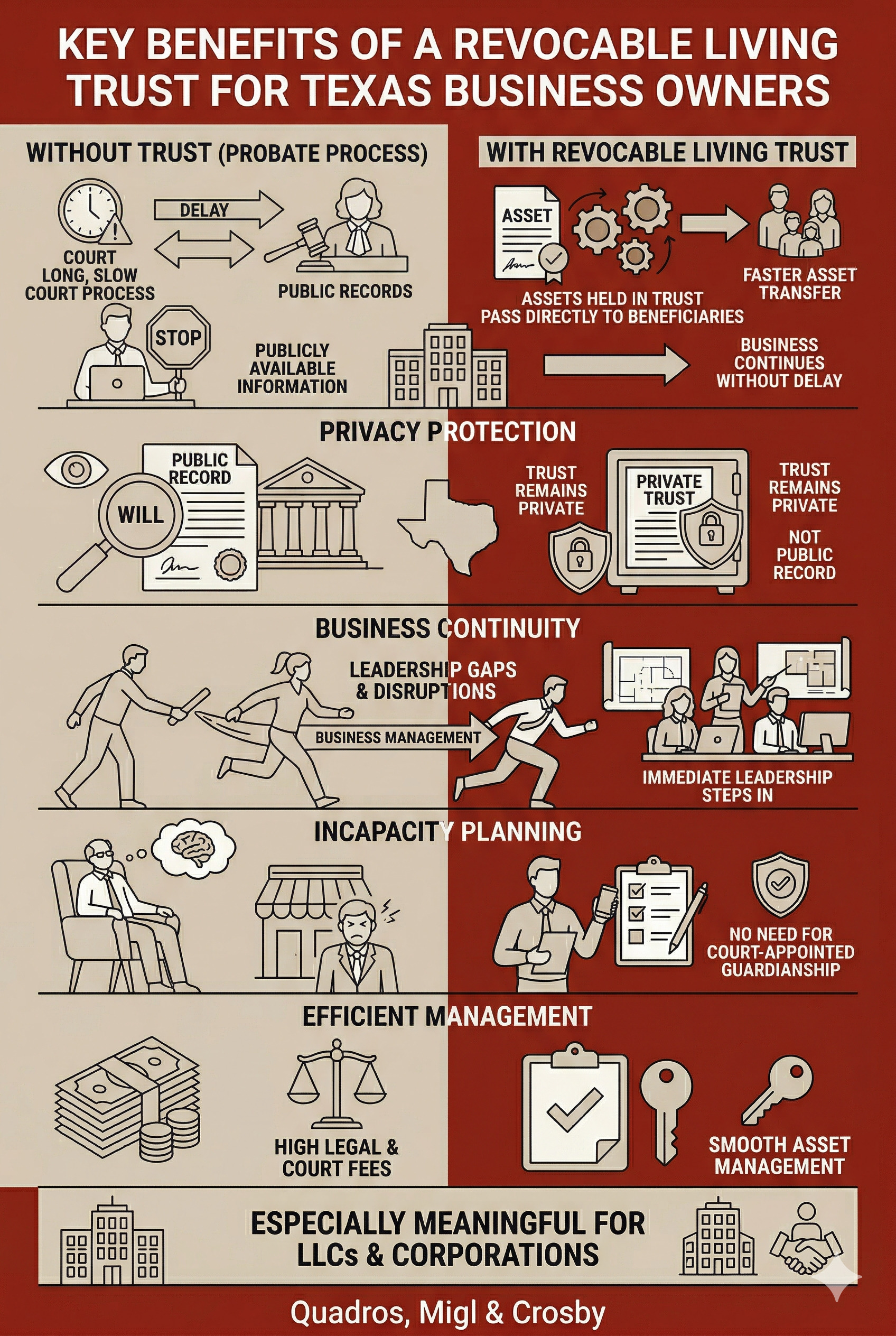
Business owners face unique vulnerabilities in the estate planning process, and a revocable trust addresses several of them directly. The benefits below are most fully realized when the trust is properly funded, meaning your assets are formally retitled in the trust’s name during your lifetime. With that in place, the following advantages are significant:
- Probate avoidance: Assets held in the trust pass directly to beneficiaries without court supervision, reducing delays that could disrupt ongoing business operations.
- Privacy protection: Unlike a will, which becomes a matter of public record when filed with a Texas probate court, a trust remains private, shielding your financial details from public view.
- Business continuity: Your successor trustee can step in immediately upon your death or incapacity to manage trust-held business interests, preventing costly lapses in leadership.
- Incapacity planning: If you become incapacitated, the successor trustee manages trust assets on your behalf without the need for court-appointed guardianship.
- Multi-state real estate: If you own property in multiple states, a revocable trust can help avoid ancillary probate proceedings in each jurisdiction.
These advantages are especially meaningful for owners of Texas business entities, such as LLCs and corporations, where ownership transitions must be handled carefully to protect co-owners, partners, and the company’s value.
What Assets Can Be Placed in a Revocable Trust?
Almost any titled asset can be transferred into a revocable trust, and doing so is central to making it work as intended. Real estate is among the most important to address, and our attorneys regularly assist clients who hold significant Texas commercial and investment real estate in ensuring those properties are properly titled in the trust. Beyond real estate, business ownership interests, financial accounts, brokerage accounts, and select other assets can all be transferred in. Assets with named beneficiaries, such as life insurance policies and retirement accounts, typically pass outside of probate already through beneficiary designations and do not need to be placed in the trust.
A pour-over will is often used alongside a revocable trust to capture any assets not transferred to the trust during your lifetime, ensuring your full estate is covered. If you are still considering your estate planning options and weighing which tools make sense for your situation, understanding how these instruments work together is an important first step.
A Revocable Trust Works Best as Part of a Broader Plan
For business owners with complex holdings, a revocable living trust is a powerful tool, but it works best when integrated into a comprehensive legal strategy. Questions around business succession, buy-sell agreements, and tax planning do not exist in isolation from your estate plan. When your estate planner also understands your business structure, the result is a more cohesive plan with fewer gaps and greater protection at every stage of your life and your company’s future.
Contact Quadros, Migl & Kilmer to Protect Your Business Legacy
Our estate planning practice has vast experience in both wealth planning and business succession matters. We are committed to developing plans that account for the full complexity of a business owner’s financial life, offering big-law caliber guidance with the personal attention that a boutique firm delivers.
If you are ready to explore how a revocable living trust can protect your business, your assets, and your family in Texas, we invite you to connect with our team. Contact Quadros, Migl & Kilmer today through our online contact form to schedule a consultation at our offices in Houston, The Woodlands, Dallas, or Austin.